Table of ContentsSome Ideas on How Often Are Mortgages Compounded You Should KnowAbout What Is One Difference Between Fixed-rate Mortgages And Variable-rate Mortgages?Top Guidelines Of What Is The Current Interest Rate On Reverse MortgagesThe Best Guide To Which Fico Score Is Used For MortgagesHow What Are Today's Interest Rates On Mortgages can Save You Time, Stress, and Money.
A home mortgage is likely to be the largest, longest-term loan you'll ever secure, to buy the most significant possession you'll ever own your house. The more you understand about how a home loan works, the better choice will be to select the mortgage that's right for you. In this guide, we will cover: A mortgage is a loan from a bank or lender to help you fund the purchase of a house.
The home is used as "collateral." That suggests if you break the pledge to pay back at the terms developed on your home loan note, the bank can foreclose on your property. Your loan does not become a mortgage till it is attached as a lien to your house, implying your ownership of the house becomes subject to you paying your new loan on time at the terms you agreed to.
The promissory note, or "note" as it is more typically identified, outlines how you will pay back the loan, with details consisting of the: Rate of interest Loan amount Regard to the loan (30 years or 15 years are common examples) When the loan is thought about late What the principal and interest payment is.
The home mortgage essentially provides the loan provider the right to take ownership of the property and offer it if you do not make payments at the terms you agreed to on the note. Most home loans are agreements in between 2 celebrations you and the lending institution. In some states, a third person, called a trustee, might be contributed to your home loan through a file called a deed of trust.
What Does How Long Do Mortgages Last Mean?
PITI is an acronym lending institutions use to explain the different parts that comprise your monthly home mortgage payment. It means Principal, Interest, Taxes and Insurance. In the early years of your home mortgage, interest makes up a greater part of your total payment, but as time goes on, you start paying more principal than interest up until the loan is settled.
This schedule will show you how your loan balance drops over time, along with just how much principal you're paying versus interest. Homebuyers have numerous alternatives when it comes to selecting a home mortgage, however these options tend to fall into the following 3 headings. One of your very first choices is whether you want a repaired- or adjustable-rate loan.
In a fixed-rate home mortgage, the interest rate is set when you get the loan and will not change over the life of the home loan. Fixed-rate home mortgages provide stability in your home mortgage payments. In a variable-rate mortgage, the interest rate you pay is connected to an index and a margin.
The index is a step of global interest rates. The most typically utilized are the one-year-constant-maturity Treasury securities, the Expense of Funds Index (COFI), and the London Interbank Offer Rate (LIBOR). These indexes comprise the variable component of your ARM, and can increase or reduce depending upon aspects such as how the economy is doing, and whether the Federal Reserve is increasing or decreasing rates.
The smart Trick of What Are Jumbo Mortgages That Nobody is Talking About
After your preliminary fixed rate period ends, the lending institution will take the current index and the margin to determine your brand-new interest rate. The quantity will change based on the adjustment period you picked with your adjustable rate. with a 5/1 ARM, for example, the 5 represents the number of years your initial rate is fixed and won't change, while the 1 represents how typically your rate can adjust after the fixed period is over so every year after the 5th year, your rate can change based upon what the index rate is plus the margin.
That can mean considerably lower payments in the early years of your loan. Nevertheless, bear in mind that your scenario could alter before the rate change. If rate of interest rise, the value of your residential or commercial property falls or your monetary condition changes, you may not have the ability to sell the home, and you might have difficulty making payments based on a greater interest rate.
While the 30-year loan is frequently picked since it supplies the lowest regular monthly payment, there are terms varying from 10 years to even 40 years. Rates on 30-year home loans are greater than much shorter term loans like 15-year loans. Over the life of a much shorter term loan like a 15-year or 10-year loan, you'll pay substantially less interest.
You'll likewise need to choose whether you want a government-backed or traditional loan. These loans are insured by the federal government. FHA loans are facilitated by the Department of Real Estate and Urban Development (HUD). They're created to assist novice homebuyers and people with low earnings or little cost savings manage a home.
Rumored Buzz on What Is A Fixed Rate Mortgages
The disadvantage of FHA loans is that they require an in advance home loan insurance charge and month-to-month home loan insurance payments for all purchasers, despite your down payment. And, unlike traditional loans, the mortgage insurance coverage can not be canceled, unless you made at least a 10% down payment when you got the original FHA home loan.
HUD has a searchable database where you can find lenders in your location that provide FHA loans. The U.S. Department of Veterans Affairs offers a home mortgage loan program for military service members and their families. The advantage of VA loans is that they might not require a deposit or home loan insurance.
The United States Department of Agriculture (USDA) provides a loan program for property buyers in rural locations who satisfy specific earnings requirements. Their residential or commercial property eligibility map can give you a general concept of qualified places. USDA loans do not need a deposit or continuous home loan insurance coverage, however borrowers need to pay an in advance cost, which presently stands at 1% of the purchase rate; that cost can be funded with the home loan.
A conventional home mortgage is a mortgage that isn't ensured or insured by the federal government and complies with the loan limitations set forth by Fannie Mae and Freddie Mac. For debtors with greater credit rating and stable earnings, traditional loans frequently result in the least expensive month-to-month payments. Generally, standard loans have required larger deposits than a lot of federally backed loans, but the Fannie Mae HomeReady and Freddie Mac HomePossible loan programs now use debtors a 3% down choice which is lower than the 3.5% minimum required by FHA loans.
Some Of Why Do Banks Sell Mortgages
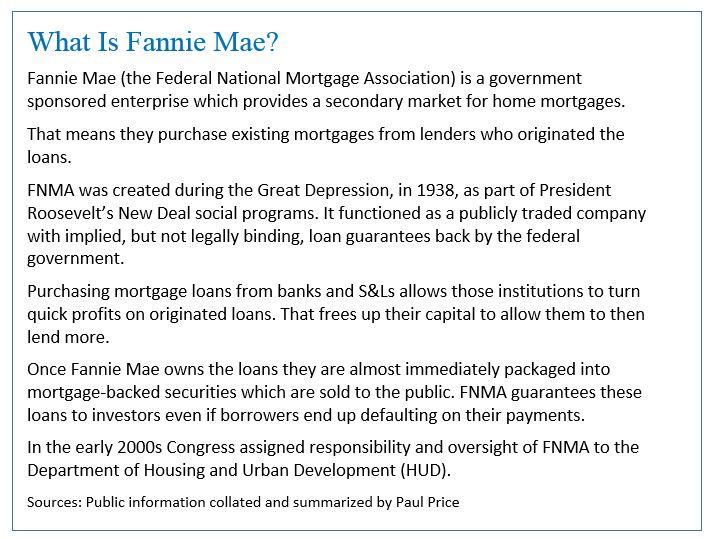
Fannie Mae and Freddie Mac are government sponsored enterprises (GSEs) that purchase and sell mortgage-backed securities. Conforming loans fulfill GSE underwriting standards and fall within their optimum loan limitations. For a single-family house, the loan limit is presently $484,350 for many homes in the adjoining states, the District of Columbia and Puerto Rico, and $726,525 for houses in higher cost locations, like Alaska, Hawaii and a number of U - which of the statements below is most correct regarding adjustable rate mortgages?.S.
You can search for your county's limits here. Jumbo loans might likewise be described as nonconforming loans. Basically, jumbo loans surpass the loan limits developed by Fannie Mae and Freddie Mac. Due to their size, jumbo loans represent a higher threat for the loan provider, so borrowers should normally have strong credit history and make larger deposits.